What is the Difference Between Disaster Relief, Recovery, and Rebuilding?
Updated: September 2026
 Chris Clum
Founder/Executive Director, Experience Mission
Chris Clum is the founder of Experience Mission, drawing on more than four decades of experience developing service-learning mission trips and working with local ministry partners. This article reflects Experience Mission's organizational approach to service-learning mission trips and was reviewed by the Experience Mission leadership team.
Chris Clum
Founder/Executive Director, Experience Mission
Chris Clum is the founder of Experience Mission, drawing on more than four decades of experience developing service-learning mission trips and working with local ministry partners. This article reflects Experience Mission's organizational approach to service-learning mission trips and was reviewed by the Experience Mission leadership team.
Understanding the Different Stages of Disaster Recovery
Relief, recovery, and rebuilding are all part of what happens after a disaster, but they are not the same thing. Relief focuses on urgent needs and helping people get through the first days and weeks. Recovery is the longer process of helping households and communities regain stability. Rebuilding is one part of that recovery work, focused on repairing or replacing damaged homes, buildings, and infrastructure. Long-term recovery can continue even after the construction work is finished.
Understanding the difference helps volunteers, churches, donors, and community partners respond to what people actually need instead of assuming the most visible problem is the only problem.
Why Does the Difference Between Relief, Recovery, and Rebuilding Matter?
The words relief, recovery, and rebuilding are often used interchangeably, but they describe different kinds of work.
Recovery rarely moves in a straight line. Emergency response may still be underway in one neighborhood while cleanup begins in another. One family may be rebuilding while another is still working through insurance, housing, paperwork, or disaster assistance. People and communities move through recovery at different speeds.
Knowing the difference can help people understand when volunteers are useful, what kinds of support may be needed, and why recovery can continue long after a disaster disappears from the headlines.
What Is Emergency Response?
Emergency response begins during and immediately after a disaster. It focuses on protecting life, health, and safety.
Depending on the event, response can include search and rescue, emergency medical care, evacuation, shelter, emergency feeding, restoring access, public safety, and initial damage assessment. Government agencies, emergency managers, first responders, utilities, local organizations, and specialized disaster organizations usually have central roles during this period.
This is not the best time for untrained volunteers to enter a disaster area independently. Roads may be unsafe, utilities damaged, communications unreliable, and local systems already under pressure.
What Is Disaster Relief?
Disaster relief follows and often overlaps emergency response. Its purpose is to meet immediate needs and help people begin to stabilize their daily lives.
Relief in a given community may include the following:
- Food and water distribution - making sure basic needs are met in the first days after a disaster.
- Temporary shelter - giving displaced families and individuals a safe place to stay.
- Emergency supplies - providing items like hygiene kits, blankets, and generators.
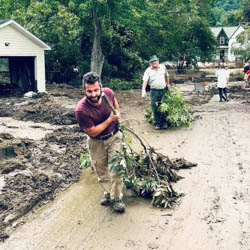
- Cleanup and debris removal - clearing damaged material so streets and properties are safer to access.
- Muck-outs and tarping - removing floodwater damage from homes and covering damaged roofs to prevent further loss.
- Basic household assistance - helping families with immediate tasks they cannot manage alone.
- Other short-term support - additional needs identified directly by local organizations on the ground.
These efforts meet real and urgent needs, but they are only the beginning of a much longer process.
Relief is often the stage people see most clearly because it happens while media attention and public concern are still high. But it is only the beginning. By the time shelters close and donated supplies are no longer the main need, many families may still be far from recovery.
What is Disaster Recovery?
Disaster recovery is a broader, usually longer process of helping individuals, families, businesses, organizations, and communities regain stability after a disaster.
Recovery work can include the following:
- Stable housing - helping people move from displacement back into a secure living situation.
- Disaster case management - helping families navigate government assistance programs and paperwork.
- Home repair or rebuilding - restoring damaged structures so families can return home.
- Financial assistance - supporting people as they work to get back on their feet.
- Emotional and spiritual care - supporting those who have experienced trauma.
- Community services - restoring schools, parks, and other shared spaces.
- Economic recovery - helping local businesses and employment recover alongside households.
- Ongoing needs - continuing to find and meet needs that persist well after initial response.
- Future preparedness - helping communities better prepare for risks ahead.
Recovery can last for months or years, and there is rarely a clean beginning or end. One family may be rebuilding while another is still dealing with insurance, housing, transportation, or basic household needs.
What is Disaster Rebuilding?
Rebuilding is one important part of disaster recovery. It focuses on repairing or replacing homes, community facilities, businesses, or infrastructure damaged or destroyed by the disaster.
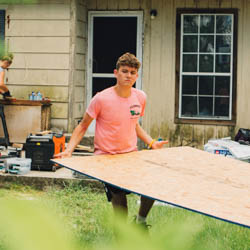
Rebuilding efforts volunteers can be part of may include roofing, framing, drywall, flooring, painting, improvements to building accessibility, and other repairs, depending on local needs and the skills, supervision, funding, and materials available.
Rebuilding is important. But finishing physical construction projects does not always mean the effects of the disaster are over. Returning to a fully repaired home can be a major milestone, even while a family is still dealing with lost income, health needs, lack of transportation, disruptions to school or childcare, increased financial pressures related to the disaster, or emotional stress.
What is Long-Term Recovery?
When the immediate emergencies are dealt with and beginning to fade, long-term recovery is the work that continues. It may still include rebuilding, but it also includes helping families return to a workable daily life, including stable housing, normal routines, and access to local services. Depending on the disaster and the household, that work can often continue for months or years after the headlines have disappeared.
Households and communities that faced economic hardships before a disaster can face an especially difficult road afterward. Their long-term recovery can be longer for many reasons, including limited insurance coverage, lower household savings, shortages of available and affordable housing, weaker social safety nets, fewer active service providers, difficulty navigating transportation, ongoing disabilities, lost documentation, contractor shortages, loss of employment, and repeated disasters in the same community. A disaster simply magnifies challenges that were already part of daily life.
Long-term recovery depends heavily on relationships. Residents, churches, nonprofits, government agencies, businesses, and other partners often have to keep working together long after the emergency phase is over. Sometimes the need is practical help. Sometimes it is connecting a family with resources, offering emotional or spiritual support, or simply staying involved when outside attention has moved on.
How Do the Relief and Recovery Stages Fit Together?
These stages often happen in this order, though they can overlap:
- Emergency Response - protect life, health, and safety.
- Relief and Stabilization - meet immediate needs and help stabilize daily life.
- Recovery - address the broader work of restoring stability for households and communities.
- Long-Term Recovery - keep working on remaining needs, support daily-life stability, follow local priorities, and prepare for future risks.
Rebuilding is not a separate stage that necessarily comes after recovery. It is an important activity within recovery and long-term recovery, focused on repairing or replacing damaged homes, facilities, and infrastructure. These are not rigid boxes or universal timelines: they overlap, and the appropriate work depends on conditions in the affected community.
Where Do Volunteers Fit in Disaster Relief and Recovery?
The right role for volunteers changes as recovery changes.
Early volunteer work may include cleanup or debris removal once authorities and local organizations determine that it is safe and useful. Later, volunteers may support home repair and rebuilding. Some recovery work requires skilled trades, specialized training, case-management experience, or other qualifications.
A desire to move quickly and meet immediate needs is not always helpful. Volunteers who want to go should seek out established organizations and local partners, assess community safety and readiness, and wait until needs have been evaluated and safe, useful work is prepared.
While teams wait for the right opportunity, there is still meaningful work to do:
- Identify volunteers - find interested, skilled people in your own community who may want to serve.
- Raise funds - gather resources that can be used in the affected community or during your eventual trip.
- Connect with a partner organization - build the relationship that will guide when and how your team serves.
- Stay informed - follow local partners as they determine what help is actually needed.
After many natural disasters, some of the best volunteer opportunities come later, when cleanup, repair, rebuilding, and other recovery needs remain long after public attention has moved on.
Why Does Experience Mission Emphasize Long-Term Recovery?
Experience Mission (EM) Disaster Relief and Recovery Trips are typically most useful after the immediate emergency response, when organized volunteer teams can support locally identified cleanup, repair, rebuilding, and longer-term recovery needs. It is not our goal to replace first responders, emergency managers, or organizations that specialize in emergency relief.
Our role begins with listening. We connect with local churches, community organizations, recovery groups, and other partners to understand what is actually needed and whether volunteers are the right resource. We also have to know that projects are ready and that lodging, supervision, tools, and other logistics can be handled responsibly.
Because of this, EM may follow a disaster closely without immediately sending volunteers. Sometimes the right decision is to wait. Sometimes another organization is better positioned to help. In other situations, the need for cleanup, rebuilding, or longer-term support becomes clearer after the initial response, and that is where EM may be best able to contribute through volunteer trip coordination.
EM also looks closely at communities affected by disasters, prioritizing places where a flood, hurricane, or tornado has made existing challenges harder. Some parts of the country or the broader world have fewer builders and tradespeople, less insurance coverage, limited infrastructure, or less access to outside recovery resources. This does not define a community's value or worth, nor does it say anything about its resilience and strength. It simply shows where long-term partnerships, volunteer teams, skilled trades, and financial resources may be especially useful over the long haul.
Why Can Recovery Continue After Public Attention Fades?
Big disasters bring cameras and news stories. But often, media attention and a willingness to give financially peak soon after the big headlines stop showing up. Recovery rarely follows the same timetable.
Homes can take months to repair. Insurance or government assistance decisions take time to sort out. Local contractors able to repair homes and other buildings may be scarce. Families may also face housing, transportation, employment, health, or financial challenges that continue long after emergency services have moved on.
That is why long-term recovery matters so much to us. Communities can look fully rebuilt from the outside while families are still living with the effects of the disaster every day. We want to respond to real local needs and relationships, not follow the news cycle or the date a construction project is finished.
What Makes Experience Mission's Approach Different?
EM does not treat a disaster-affected community as a project to complete or a headline to chase. We wait for local partners to tell us what is needed, we prioritize long-term recovery alongside relief and rebuilding, and we pay attention to communities that may have fewer outside resources once the news cycle moves on. Volunteer teams serve alongside local churches and organizations that are already doing the work, rather than arriving with a predetermined plan.
Frequently Asked Questions
Is disaster relief the same as disaster recovery?
No. They may sound like the same thing, but relief generally focuses on immediate needs and getting people stable. Recovery is broader and often a longer-term process of restoring housing, services, livelihoods, community systems, and stability after a disaster.
Is rebuilding part of disaster recovery?
Yes. Rebuilding is one important part of recovery, but it does not cover everything a family may be facing. Even after a home is repaired, people may still be dealing with work, transportation, finances, health, school, emotional or spiritual needs, and the challenge of rebuilding normal routines.
When does long-term recovery begin?
There is no single timeline for when relief efforts end and long-term recovery begins. Long-term recovery develops as immediate response and relief needs decrease and unresolved household and community needs become clearer. It often continues alongside rebuilding efforts and may even extend beyond it. Different households and parts of the same community may enter long-term recovery at different times, depending on how quickly they reach a stable place after the disaster.
Why shouldn't volunteers arrive immediately after a disaster?
Uncoordinated volunteers can create real problems in the immediate aftermath of a disaster: adding traffic to roads, consuming already-scarce lodging and food, entering unsafe areas without knowing it, or attempting work that local, state, and federal authorities have not prioritized. Volunteers should wait for verified opportunities through established organizations and local partners, and step in when the time is right.
How long does rebuilding continue after a disaster?
The rebuilding timeline varies widely depending on the total amount of damage, availability of insurance and assistance funding, permitting timelines, housing supply, contractor availability, local capacity, and individual household circumstances. All of these factors can extend the rebuilding timeline by months or years for a given community.
Does every disaster move through these stages in the same way?
No. The stages overlap, and every community experiences recovery differently. The type of disaster, scale of damage, available resources, local capacity, housing conditions, and individual household circumstances all affect the recovery process.
Learn More About Disaster Relief and Recovery
Explore Experience Mission's Disaster Relief and Recovery Trips and join the Disaster Relief and Recovery Network to stay informed and participate when locally identified needs are ready for outside support.
About the Author
Further Reading




Site developed and hosted by Skycog, Inc.